By Nate Porceng, Skadden Fellow
Electricity bills around the United States are skyrocketing. (CNN). In Pennsylvania, household electricity prices have shot up nearly 50 percent over the past five years. (Inside Climate News). Ratepayers in Ohio and West Virginia have also experienced dramatic price increases. Low and middle-income households have had a hard time keeping up. (Pa. Capital-Star). In 2025, nearly 290,000 Pennsylvania households had their electric service disconnected for falling behind on their payments — a 14 percent increase from 2024. (Pa. PUC).
Losing electric service can harm physical and mental health. (ABC News). In the most extreme cases, disconnection can result in homelessness or death. (Nature). To “keep the lights on,” families may forgo food, medicine, child care, and other basic needs. (Pa. Capital-Star).
Given the stakes, it’s important to understand how electricity prices are set, why costs are going up, and, most importantly, what we can do about it.
WHO OWNS UTILITIES?
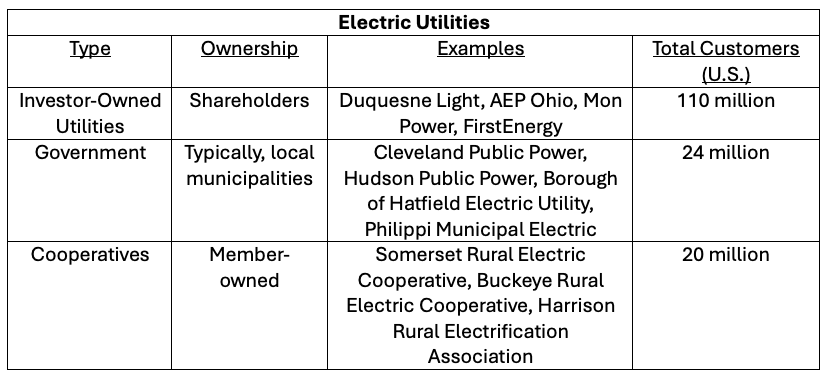
There are three types of electric utilities. (US EIA). The first are those owned and operated by the government. The second are member-owned cooperates, most common in rural stretches of the Midwest and Southeast. The third are investor-owned utilities. Investor-owned utilities are large “electric distributors that issue stock owned by shareholders.” (US EIA). Essentially, they are large for-profit businesses. The vast majority of U.S. households get their electricity from investor-owned utilities, particularly in Pennsylvania, Ohio, and West Virginia. Duquesne Light Company, AEP Ohio, and Mon Power are just a few examples of investor-owned utilities. (EEI).
Utility companies are essentially government-sanctioned monopolies. (Canary Media). The government grants the companies exclusive rights to distribute and sell electricity within their service areas. The government also guarantees that the companies will receive a certain return on their investments—typically around 8 to 10 percent. In return, utility companies are supposed to provide safe, affordable, and reliable energy to customers within their service area.
WHO DECIDES HOW MUCH WE PAY FOR ELECTRICITY? AND HOW?
Utility companies must request rate increases from their respective state public utility commission. Examples of state utility commissions include the Pennsylvania Public Utility Commission, the Public Utilities Commission of Ohio, and the Public Service Commission of West Virginia. The utility companies need to state their new proposed rates and prove why the increased costs are necessary. (PA PUC). The state utility commission is supposed to ensure rates are as low as possible for consumers while keeping utility companies financially stable. Individual consumers and public interest groups may participate in ratemaking proceedings by filing complaints with the state utility commission or by offering public comments.
For more information on how to file complaints with state utility commissions or offer public comments, check out the following links:
To file complaints or public comments with state utility commissions, click here:
WHY ARE OUR UTILITY BILLS GOING UP?
There are several reasons electric utility bills have ballooned over the past few years. (Canary Media). These factors include inflation, continued reliance on fossil fuels, extreme weather, and overseas wars. The rapid buildout of artificial intelligence (“AI”) data centers has also driven up electric bills. (Canary Media).
HOW DO AI DATA CENTERS DRIVE UP ELECTRIC BILLS?
AI data centers need immense amounts of energy to operate. “A single large data center can consume as much electricity as 50,000 homes.” (MIT). Even “self-generating” data centers may demand backup power from the grid. This increased demand has outpaced the construction of new electric generation projects and forced grid operators to procure electricity from more expensive sources, driving up prices. The independent monitor for PJM—the organization that manages the electric grid in Pennsylvania, Ohio, West Virginia, and ten other states—estimates that data centers will drive over $6 billion in added costs for other customers in the region between 2027 and 2028. (Monitoring Analytics)
Utility companies may also need to construct or upgrade their infrastructure in order to serve AI data centers. (Harvard Law News). In theory, data centers are supposed to pay most or all of these added infrastructure costs. But without proper regulations, utility companies may try spreading the costs to residential ratepayers. If proposed data centers fail to materialize or go out of business, other ratepayers may end up footing the bill for unpaid infrastructure.
IS RENEWABLE ENERGY CAUSING ELECTRIC BILLS TO GO UP?
If anything, the lack of renewable energy has caused electric bills to go up. (Canary Media). Over reliance on fossil fuels—particularly oil and natural gas—is a significant reason utility bills have skyrocketed over the past few years. Solar energy is now “generally cheaper than fossil fuels” even without government subsidies. (Sabin Center).
WHAT IS PRIVATE EQUITY AND HOW MIGHT IT AFFECT OUR UTILITY BILLS?
Harvard Law School offers this helpful definition of private equity:
Private equity (PE) is ownership of (or an interest in) an entity that is not publicly traded. Often, it is high net worth individuals and/or firms that purchase shares of privately-held companies or acquire control of publicly-traded companies (and possibly take a public company private). The aim is to invest in companies that have growth potential and then use the private equity investment to turnaround or expand the business. The company can then be sold for a profit.
Basically, private equity firms aim to buy companies, pump up their value over a short period of time, and then sell them for profit. (Wired). Private equity firms do not necessarily make money by improving the companies in which they invest. In fact, their short-term pursuit of profit may hurt the long-term health and stability of the companies they purchase. Private equity firms often saddle the companies they take over with massive amounts of debt, cut staff, and unload vital assets—moves that may juice profits for the firms but destabilize the companies. (The Guardian). Private equity firms have expanded into all sorts of businesses and services, from preschools and youth sports to hospitals and municipal water supplies. (The Guardian; NPR).
Private equity firms have heavily invested in AI data centers. (AP News). They have also begun investing in investor-owned utilities. These investments may create conflicts of interest if a private equity firm owns stakes in both a utility company and data centers that company serves. Private equity firms may also try to maximize their profits by driving up prices or delivering lower quality services.
WHAT CAN WE DO?
One way to get involved is by following and participating in proceedings before your state’s public utility commission. (Pennsylvania, Ohio, West Virginia). You can even link up with your fellow community members and participate together. While you do not necessarily need a lawyer to participate in utility commission proceedings, one may come in handy drafting complaints and comments.
You can also contact your local legislators. Federal, state, and local policymakers across the country are trying to figure out solutions to the AI boom and rising utility bills.
WHAT IF I CAN’T PAY MY UTILITY BILLS RIGHT NOW?
If you are struggling to pay your utility bills, you may qualify for financial assistance. Contact your utility company or state administrators for more information. (Pennsylvania, Ohio, West Virginia).
Fair Shake is here to help: check out Fair Shake’s resource library for toolkits and local resources to get involved or reach out to our team to talk more about community action and legal services.