Right to knows and Government Transparency
Trying to get involved and make a difference is hard. The system can feel broken, confusing, unfair, and rigged. You may be shuffled from one person to another agency to a separate department, and still not get your questions answered or feel like anybody heard you.
AND it’s the way that we can make change to help bring your community’s vision to action. We believe that knowing how to navigate this complexity can help you harness your limited and precious time, energy, and capacity to know where to push, where to comment, how we can shift the system, and where to get information you need to help your community stay healthy and happy.
SUNSHINE ACT
Sunshine Act and Open Government laws require that all agencies talk about issues out loud and take official action on agency business in an open and public meeting. Most debate and deliberation needs to happen in public, although there are some special exceptions.
These laws require that meetings have prior notice, and that the public can attend, participate, and comment before an agency takes that official action.
Understanding and pressing that decisions are made in the open can help unlock transparency and understanding.
Decision-Making Power: Community
file right to know requests
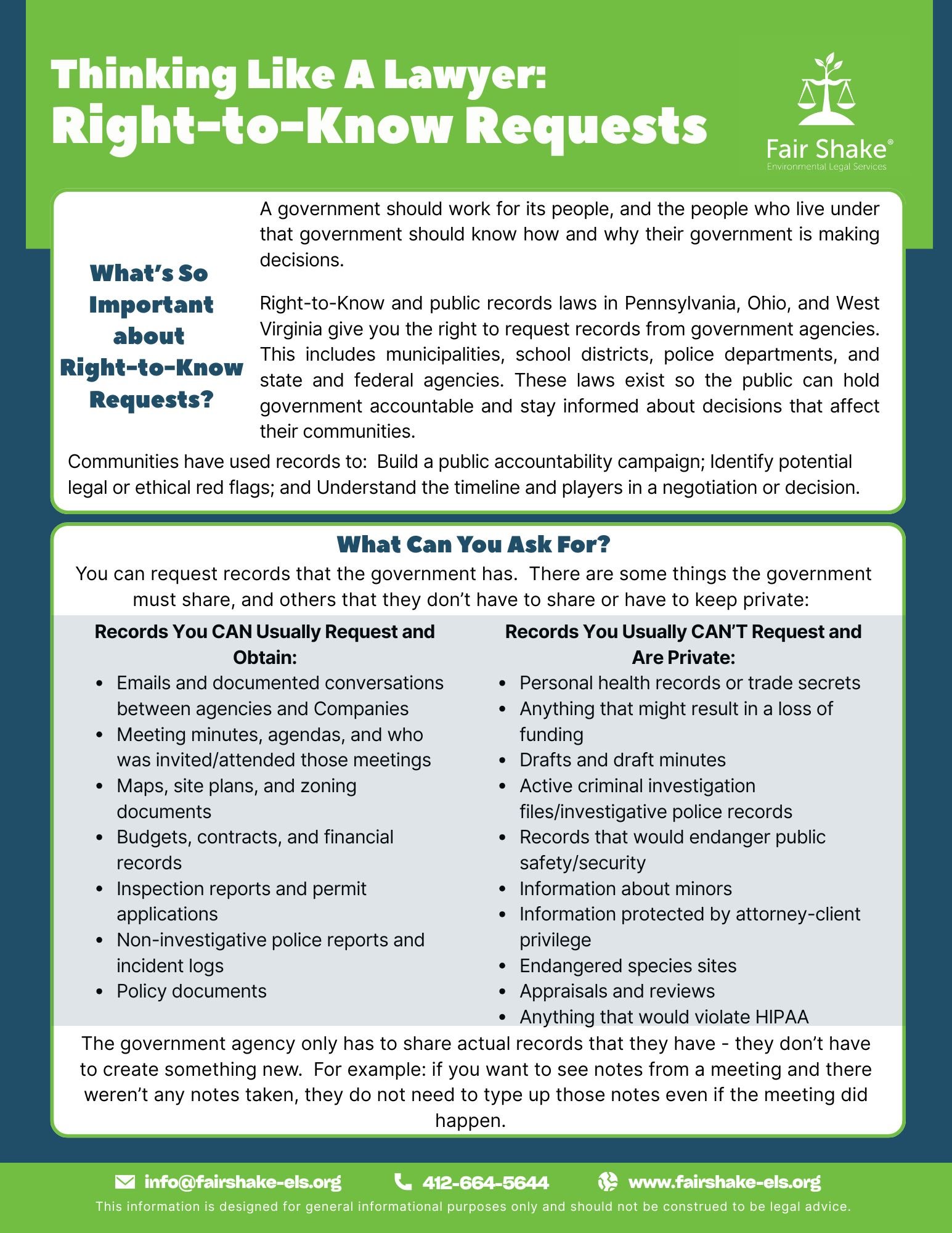
The public has a right to access, read, and review all government records, with a few exceptions. This includes documents, papers, letters, maps, books, tapes, photos, sound recordings, email, and other information stored by a local, county, state, and federal agency.
Filing a Right to Know Request allows you to see those communications to understand what is being discussed and debated and who is involved.
Right to Know Requests can help you navigate the complex bureaucracy to understand what is happening and who is making decisions.
Decision-Making Power: Community
-
It’s important to do these with some frequency (example: quarterly, every 6 months). This will allow you to stay up-to-date and catch new decisions coming down the pipeline, and ideally catch them early enough to impact.
The earlier you find out about a new development that doesn’t align with your vision, the more time and options you have to drive your vision.
-
Make specific asks with specific timeframes.
Avoid broadness or fishing for information – this just delays the process.
Do not use the Right To Know to ask questions.
Make sure to add the full company name (ex: Company, LLC or Company Inc.]
Make sure to include email if you want all communications (some administrators don’t think that email is included in communications so will only send back letters.)
Example: “All communications, including applications, reports, emails, or other submissions, between [Company Name] and [the Dept, etc.] regarding [Address of Company], since May 16, 2023..
-
This activity may be easier for someone or a team who has these strengths:
Executing + Doing
-
Tips:
Some agencies have their own Right to Know Request Forms. When possible, use the agency’s specific form. If there isn’t a form, you can find great examples and tips here:
PA: https://www.openrecords.pa.gov/RTKL/HowToFile.cfm
Ohio: https://www.acluohio.org/en/news/so-you-want-submit-public-records-request
West Virginia: https://www.nfoic.org/west-virginia-foia-laws/
Example Right to Knows and More Tips: https://www.nfoic.org/state-sample-foia-request-letters/
-
Here are some flags that may alert you if deliberations are not happening in public. If you think that agencies are not complying with the Sunshine Act, this could be sign that it may be time to to talk with an attorney.
Very quick meetings
Decisions for big projects seemingly coming out of nowhere
Lots of executive sessions taken during public meetings
Lack of responses to right to know requests
Lack of discussion at public meetings before decisions are made/voted on (indicates improper discussions were occurring not in public meetings)
Vague meeting agendas released with little time for public review.
Lunches or dinners that public officials attend together before meetings. Public business often gets hashed out during those unofficial gatherings, but that is very hard to prove.
-
This activity may be easier for someone or a team who has these strengths:
Executing + Doing
-
Ohio:
What You Should Know About Ohio’s “Sunshine Laws”: https://www.ohiobar.org/public-resources/commonly-asked-law-questions-results/courts-and-lawyers/what-you-should-know-about-ohios-sunshine-laws/
Ohio Sunshine Laws Frequently Asked Questions: https://www.ohioattorneygeneral.gov/faq/sunshine-laws-faqs
Pennsylvania:
Guide to the Pennsylvania Sunshine Act: https://panewsmedia.org/legal-and-legislative/guide-to-the-pennsylvania-sunshine-act/
A Citizen’s Guide to The Pennsylvania Sunshine Act: https://blogs.law.widener.edu/envirolawcenter/files/2010/03/PA_Citizens_Guide_re_Sunshine_Act.pdf
West Virginia:
The Open Governmental Meetings Act: https://ethics.wv.gov/openmeetings/Pages/default.aspx#questions
Open Meetings Act: https://wvpress.org/legal/open-meetings-act/
Looking for Support?
Let us know how we can help.