the Current
community organizing - resources and tools
Below are resources for community organizers.
A current moves through the river and impacts how fast, slow, smooth, or rough the water moves. Similarly, the Community Democracy Current are the activities, resources, and tools that impact how easy or hard it will be for you as you pull levers for change up- mid- or downriver.
The more of these activities you are able to work on, the quicker and smoother you “River” may be.
Click here for the "Choose Your Own Adventure" River Website.
What are your strengths?
-
You build and nurture strong relationships, and build bonds between others.
You may... be adaptable, believe things happen for a reason, believe in and love to help others, can feel the emotions of others, always helping others to find agreement, include others and make them feel welcomed, see each person’s uniqueness, see the glass as ‘half full’, have a few really close friends.
-
You take charge, speak up, and make sure others are heard?
You may... speak up, take charge, be able to explain things and use your words well, be competitive, strive for excellence, believe in yourself, like to be appreciated and stand out from others, love meeting new people and getting them to like you.
-
You see and stretch thinking for the future.
You may... ask lots of questions, like having ‘hard data’, learn from what’s happened in the past, dream about the future, get excited about new ideas, love to learn new things, love to think things through, find the best way forward even when things are confusing.
-
You make things turn into reality.
You may... love to get things done, keep track of lots of moving pieces, have strong core values that give you direction, expect rules to be applied to everyone, plan ahead, love routines, set goals for yourself, feel responsible to follow-through, love to solve problems.
We all have our unique strengths. These are the activities that come naturally and that make us feel happy when we do them.
Knowing your strengths can help you focus your organizing work on what you do best, and make sure you bring other people with you who can fill in your gaps.
The goal = have a team that has all four strengths.
strategizing and planning
Having goals and structure in place, and brainstorming how to work toward your goals, can help you plan out your time, energy, and team.
-
Action Strategy: A How-To Guide by The Ruckus Society
visioning
Create a Shared Vision
Creating a shared vision can spark ideas, drive change, keep ideas moving forward, and be a place to re-group when conflict or barriers come up.
Once you have the vision, you can then:
Spot strengths and problems that your town is facing in your vision right now;
Find the root cause of the problems;
Figure out the different paths that can get at the root cause of the problems;
Talk about the pros and cons of the different paths.
Find 1-3 paths to focus on now - these become your primary goals.
Figure out the legal or technical lever that can meet your goals.
Decision-Making Power = Community
-
Visions are the big, big, big dreams of where the community wants to be in the future. Often visions can get stuck at the goal-level, but visions can be big! And bold! In general, visions are imagined and felt, while goals are thought and done.
Examples:
Vision: our community is happy and healthy, people have safe and affordable places to live, young adults choose to stay here, and the river is a part of our community.
Strengths + Problems: Some neighborhoods have a lot of trees and green space. Lower-income neighborhoods have fewer trees and green space, leading to hot conditions and more air pollution.
Root cause: Budgeting prioritizes trees in higher-income neighborhoods.
Goal: advocate and pass ordinance for local tree committee to advance trees in lower-income neighborhoods, and give committee some budget for trees planting and maintenance.
Lever: New Ordinance (local law) to create tree committee
-
This activity may be easier for someone or a team who has these strengths:
Relationship Building + Feeling
Strategy + Thinking
-
Practical Steps to Growing a Community Vision: https://inspiringcommunities.org.nz/ic_resource/practical-steps-for-growing-a-community-vision/
Re:imagine Appalachia Re:Imagine Your Community Toolkit: https://reimagineappalachia.org/faith-in-action/
ReImagine Beaver County - Community Visioning Session Video: https://www.youtube.com/watch?v=eDEvOHcfPu0
Facilitation Strategies: https://www.sessionlab.com/library
Root Cause Analysis (5 Why’s): https://kanbanize.com/lean-management/improvement/5-whys-analysis-tool
find the root causes
Once you have a vision, then you can think about how your community is meeting - or not meeting - that vision. This involves knowing what is working well in your community - your strengths and assets - and what are issues or problems.
Without finding the root cause, you could work hard to solve of symptom of the problem, which could lead the problem to keep popping up again in the future. Imagine you had a broken wrist and it hurts! The doctor said the solution was painkillers. Just solving for the pain doesn’t heal your wrist or help you not break it again in the future - for that you would need different solutions.
Finding the root cause of your strengths will help you see what you can build from.
Finding the root cause of your issues will help you find solutions that will actually address the problem head-on.
Decision-Making Power: Community
-
This activity may be easier for someone or a team who has these strengths:
Strategy + Thinking
Executing + Doing
-
5 Why’s: https://tulip.co/glossary/five-whys/
Root Cause Analysis: https://www.mindtools.com/ag6pkn9/root-cause-analysis
Find funding and Ways to pay for your vision
Finding a way to pay for economic development, new ways of doing things, programs and services to meet community’s needs, and other local needs, is an important piece of the puzzle.
Without a way to pay for the vision, many municipalities will not be able to move a vision forward.
Funding can come from local, regional, and national foundations; state or federal government programs; or municipal budgets; and private investment.
How you can get involved:
Research and find funding streams that match your vision.
Share funding streams with your decision-maker.
Help to build a collaboration of nonprofits, local government, and community members that are interested in the same vision.
-
This activity may be easier for someone or a team who has these strengths:
Strategy + Thinking
Executing + Doing
-
Just Transition Fund: The Center will support community organizations seeking federal grants to advance projects related to economic and workforce development, economic diversification, and broadband access and affordability that are essential for creating an equitable, inclusive, and low-carbon future, including grant-making and technical assistance. https://justtransitionfund.org/federal-grant-support/
Interagency Working Group: This government-wide list offers easy access to Energy Communities applying to fund infrastructure, environmental remediation, job creation, and community revitalization efforts. https://energycommunities.gov/funding-opportunities/
United States Conference of Mayors: Help local leaders zero in on the opportunities that align with community priorities. https://localinfrastructure.org/funding-opportunities/
American Cities Climate Challenge: This tool helps local governments prioritize and leverage existing federal funding to advance system-wide energy transition goals—from block grants and technical assistance to competitive grants and loans. https://cityrenewables.org/ffold/?_sfm_sector=Industry
Power A Clean Future Ohio: technical support is limited to grants focused on energy efficiency, transportation electrification, and renewable energy. https://www.poweracleanfuture.org/igap
Green Bank for Appalachia: This Green Bank and related programming are envisioned to be funded at $1 billion to provide financing for development transactions and growing businesses, and will partner with financial institutions – banks, CDFIs, credit unions, New Markets Tax Credit Funds, Opportunity Zone investors, Historic Tax Credit investors, public sector Revolving Loan Funds, Angel Investment funds, and other impact investors — to leverage substantial new investment in rural communities: https://appalachiancommunitycapitalcdfi.org/oa-program/green-bank-for-appalachia-energy-communities-and-underserved-rural-america/
Engaging Your Community
grow strong relationships
Growing strong and trusting relationships is the spark to community change. It is ongoing action that takes time and attention to connect with partners and in real and authentic ways.
Authentic Relationship Building (ARB) is a way to think about your relationships before, during and after connecting to assess how you want to build relationships with neighbors, partners, decision-makers, and community.
Decision-Making Power = Community
-
Build authentic relationships with those who :
Will be most impacted;
Have experience and expertise with the problem you’re trying to solve;
Will likely anticipate risks and problems that you might miss;
Have desires or considerations that might be in the minority or be different from yours;
Have personal identities, experiences, or roles that may be on the margins of your team;
Have been historically left out of similar decision-making processes.
-
This activity may be easier for someone or a team who has these strengths:
Relationship Building + Feeling
Influencing + Motivating
Strategy + Thinking
Executing + Doing
-
Inclusive Civic Engagement: https://kirwaninstitute.osu.edu/sites/default/files/2016-05//ki-civic-engagement.pdf
Stay for Dinner Toolkit: https://drive.google.com/file/d/1FPpw5qM9HRiYdZz4bWHHtQ3AymIo0erz/view
Relationship Building & Social Change: https://www.lrng.org/interfaith-youth-core/playlist/interfaith-cooperation-civil-rights-act/activity/relationship-building-social-change
Organizing: People, Power, Change: - https://d3n8a8pro7vhmx.cloudfront.net/themes/52e6e37401925b6f9f000002/attachments/original/1423171411/Organizers_Handbook.pdf?1423171411
engage Your Relationships + Community
Community engagement is the next step of authentic relationship building. Once you have a big, bold, and diverse table, it's time to engage those relationships to move the issue and energy forward!
Engaging is about the actual relationship, conversations, and the follow-through and trust building on the other end.
It can often feel like you are ‘swimming’ in outreach and engagement. Thinking strategically about what strategies and activities you can use can be helpful:
Saturate the environment – activities that reach everybody but don’t lead to a lot of people showing up when it’s time.
Mobilize champions – providing the support, information, and tools to help trusted members of the community put the ‘stamp of approval’ on your issue and help talk to others. Can be a really helpful way to engage others.
1:1 conversations – looking for opportunities to have face-to-face conversations with people to share your story and respond to them individually. Can be the most impactful way to engage others.
Decision-Making Power: Community
-
This activity may be easier for someone or a team who has these strengths:
Relationship Building + Feeling
Influencing + Motivating
Strategy + Thinking
Executing + Doing
-
Safety Planning, The Ruckus Society
Using Fair Process to Make Better Decisions, The Management Center: https://www.managementcenter.org/resources/using-fair-process-to-make-better-decisions-a-quick-start-guide/?utm_source=Management+Center+Resources&utm_campaign=d9ba32c8bb-EMAIL_CAMPAIGN_2020_05_06_01_02_COPY_01&utm_medium=email&utm_term=0_c9e85c2aa3-d9ba32c8bb-410504448
Equitable and Inclusive Civic Engagement, The Kirwin Institute: https://organizingengagement.org/models/six-principles-for-equitable-and-inclusive-civic-engagement/
From Community Engagement to Ownership: Tools for the Field with Case Studies of Four Municipal Community-Driven Environmental & Racial Equity Committees: https://www.usdn.org/uploads/cms/documents/community_engagement_to_ownership_-_tools_and_case_studies_final.pdfhttps://www.usdn.org/uploads/cms/documents/community_engagement_to_ownership_-_tools_and_case_studies_final.pdf
clarify Roles + Responsibilities
Strong collaborations and coalitions are important to move any change work forward. It can also be a challenge to bring different voices, ideas, skills, and needs into the room.
Step 1: Figure out individual strengths: There are many ways to help everyone name their strengths or skills. Here are two ideas:
Community Strengths Quiz (below)
Step 2: Complete the Group Strengths + Challenges activity (below).
Step 3: Assign Roles and Responsibilities using MOCHA.
Step 4: Continue to come back to these roles over time and as work shifts and changes.
-
This activity may be easier for someone or a team who has these strengths:
Relationship Building + Feeling
Influencing + Motivating
Strategy + Thinking
-
Clarifying Responsibilities with MOCHA: https://www.managementcenter.org/resources/assigning-responsibilities/
Building Movement Project Social Change Ecosystem Map: https://buildingmovement.org/our-work/movement-building/social-change-ecosystem-map/
Gallup Clifton Strengths: https://www.gallup.com/cliftonstrengths/en/253715/34-cliftonstrengths-themes.aspx
Starting a Coalition: https://ctb.ku.edu/en/table-of-contents/assessment/promotion-strategies/start-a-coaltion/main
Maintaining a Coalition: https://ctb.ku.edu/en/table-of-contents/assessment/promotion-strategies/maintain-a-coalition/main
Communications and Messaging
Tell Your Story
Storytelling is an important part of social change. Stories have the power to:
Change how we think, feel, and remember.
Elicit more empathy from the listener.
Bring people together and build community.
Gives the chance for each person to share a situation from their perspective.
Help uncover themes and patterns which can lead to solutions.
Decision-Making Power: Community
-
After you’ve developed your story and strategic messaging, share it widely! This can help bring in more people to create a loud and shared voice. The more people sharing their story, the more pressure that decision-makers feel.
There are many ways to share your story + make your message heard, especially after you’ve engaged other relationships to make your story and message be even louder. Think about who you want to hear your story to help figure out where to share it:
TV stations
Radio stations
Talk with a Newspapers & city papers reporter
Create a social media campaign
Write a letter to the editor
Publicly display art, photos, and other visuals around town. (Think about libraries, coffee shops, restaurants.)
Share in email & bulletin blasts. (Think about churches, PTA’s, nonprofit groups, and other groups who share your vision to collaborate with.)
-
Stories can be shared through visuals and images; spoken word; and written word.
Use written communications when you want to: to share facts; make sure it’s on a permanent record that you can use for accountability; when you have time (you don’t need an immediate response or immediate feedback); and to explain complicated ideas.
Use verbal & visual communications when you want to: share emotions; when you do not need a permanent record; when the matter of urgent and you need immediate engagement; and for simple, easy-to-explain ideas.
-
This activity may be easier for someone or a team who has these strengths:
Influencing + Motivating
-
The Opportunity Agenda interactive VPSA message building tool: https://opportunityagenda.org/our-tools/vpsa/
Creative Advocacy Playbook (Riverwise + New Sun Rising): https://www.newsunrising.org/creative-advocacy/
Voice of Witness Lesson Plans: https://voiceofwitness.org/education/lesson-plans/
Storytelling for Social Change + Building a Story: https://www.evidenceforaction.org/sites/default/files/2022-01/Messaging-Brief-Jan22.pdf
Develop Strategic Messaging
Strategic messages shift how you tell your story to meet the other person where they are at, hopefully bringing them along with you.
Decision-Making Power: Community
-
This activity may be easier for someone or a team who has these strengths:
Influencing + Motivating
Strategy + Thinking
-
Media Training 101 for Organizers: https://youtu.be/ZSf-1ynGMS0
Helpful tool for message development: https://www.bmsg.org/wp-content/uploads/2020/09/bmsg_message_development_worksheet.pdf
Message tips for different audiences: https://climatecommunication.yale.edu/publications/global-warmings-six-americas-book-chapter-preview/
Being Part Of Decision-Making
Learn how your local government functions
Learning how your municipality is set-up will help you know who holds decision-making power, how decisions are made, and current processes, rules, and laws.
Where to start?

Decision-Making Power: Each layer of government has to follow rules and laws created by the outer layers. Each layer has power to make decisions about the things listed in the green boxes.
Municipal website & facebook pages. Look for: who has which positions? What boards, committees, or commissions are there? When do different decision-making bodies meet? What has been covered during recent agendas and notes?
Search or look on municipal website for: local zoning maps and comprehensive plans; municipal code book (which has all of the ordinances.)
Schedule a time to talk with your representative to ask them questions.
Other people who may know: reporters, librarians.
Decision-Making Power: Community
What To Expect in a Municipal Meeting
-
Municipalities are allowed to create Boards, Commissions, and Committees to help oversee and provide advice on different topics. This could include things like planning, housing, ethics, equity, transportation, economic development, and public safety. Many Boards, Commissions, or Committees are volunteer positions.
Board: usually is a formal committee created by an ordinance with structure, responsibilities, and powers. Decision-making power: sometimes a quasi-judicial body that can make decisions over their issues, such as licensing or regulation. Sometimes a Board can only provide advice and recommendations. Example: Board of Appeals is a group of people who hears and decides appeals to the zoning ordinance.
Commission: usually formal committee created by an ordinance with structure, responsibilities, and powers. Decision-making power: usually administrative to complete reviews, studies, and make recommendations about their issues. Example: Housing Commission can study community’s supply of affordable housing and make recommendations to governing body.
Committee: can be formal committee created by an ordinance, or an informal committee created by the mayor or governing body. Decision-making power: usually provides advice and recommendations. Example: Downtown Development Task Force would advise the mayor and council on economic development in the downtown area.
-
This activity may be easier for someone or a team who has these strengths:
Strategy + Thinking
Executing + Doing
-
Power Mapping Activity - https://docs.google.com/document/d/11E060vzpTEPhTDQLcvT21_ttxoZ8EvU3VHb2JFsT0Vo/edit
Infographics - Common Structures of Local Governments: https://cityhallfellows.org/category/how-cities-work/various-structures-of-local-government/
25 Reasons You Should Get Involved with your Local Government: https://www.rocksolid.com/blog/25-reasons-why-you-should-get-involved-with-your-local-government
Roberts Rules of Order Cheat-Sheet: https://diphi.web.unc.edu/wp-content/uploads/sites/2645/2012/02/MSG-ROBERTS_RULES_CHEAT_SHEET.pdf
Law, Rule, Regulation and Policy Definitions: https://www.yakimacleanair.org/services/definitions.html
Pay attention to your decision-makers
…or become part of an already-existing watchdog that shares your vision.
It’s important to observe, see, and read about what is happening in your municipality to catch future decisions early; hold the municipality accountable to listening and honoring community needs and ideas; and to understand the ‘why’ behind decisions.
It can be almost impossible for one person to track all municipal meetings, agendas, and notes – it takes a team to do this! A ‘watchdog’ group could be joining or creating a nonprofit community group; creating the structure behind this; or joining with a larger group who already does in this work.
Ways you could get involved:
Go to local board or commission meetings
Read agendas
Read notes from after the meeting
Follow social media pages
Watch recordings of meetings or ask your decision-makers to post meetings on youtube
Decision-Making Power: Community
-
This activity may be easier for someone or a team who has these strengths:
Executing + Doing
Strategy + Thinking
-
How to Monitor your Local Government ACLU: https://www.aclu-nm.org/en/aclu-nm-civic-engagement-training
become part of your local municipality
Local municipalities are made of neighbors who care about their neighbors, and everyone has strengths that they can add to their municipality.
By being part of your municipality, you could have the power to listen to community; create and nominate board and committee members; approve permitting and zoning decisions; create local laws and rules; and create the budget; and oversee utilities, libraries, fire and police departments, and parks.
There are many ways to be at the table to make decisions, including running for elected positions such as mayor or city council. If you don’t want to run, many municipalities have boards, committees, or commissions that have vacant positions that require an application process. All positions can help shape where your community goes in the future.
It requires a time & transportation commitment – most positions are volunteer positions that require time to join bi-weekly or monthly meetings, research, and preparation time, as well as transportation to and from meeting venues.
Decision-Making Power: Community
-
This activity may be easier for someone or a team who has these strengths:
Relationship Building + Feeling
Influencing + Motivating
Strategy + Thinking
Executing + Doing
-
Action Tank City Council Bootcamp: https://www.actiontankusa.org/ccb
Run for Something: https://runforsomething.net/
Vote in Local Elections
…and help others vote, too!
Many local decision-makers are elected offices and have a lot of power to listen to community; create and nominate board and committee members; approve permitting and zoning decisions; create local laws and rules; and create the budget. They also run utilities, libraries, fire and police departments, and parks!
These local positions may vary slightly depending on where you live, but may include:
Mayor
City councilmember(s) or commissioners
County commissioners
-
This activity may be easier for someone or a team who has these strengths:
Relationship building + feeling
Influencing + motivating
Strategy + thinking
Executing + doing
-
League of Women Voters: https://www.lwv.org/
Register to Vote: https://vote.gov/
Create a Personalized Ballot: https://www.vote411.org/ballot
Hot Tips to Rock the Ballot Booth - Local Elections! https://vimeo.com/180771523
How to Pick A Candidate: https://lwvnewton.org/voters-service/how-to-pick-a-candidate/
For 501(c)(3) - Resources from Bolder Advocacy
Ohio Nonprofit Voter Assistance Guidance: https://bolderadvocacy.org/resource/practical-guidance-ohio-nonprofit-voter-assistance/
PA Nonprofit Voter Assistance Guidance: https://bolderadvocacy.org/resource/practical-guidance-pennsylvania-nonprofit-voter-assistance/
Conducting or Funding a Voter Registration Drive: https://bolderadvocacy.org/resource/want-to-conduct-or-fund-a-voter-registration-drive/
Keeping Nonpartisan during Election Season: https://bolderadvocacy.org/resource/keeping-nonpartisan-during-election-season/
learning about your community’s health and wellbeing
research your community’s health + environmental justice
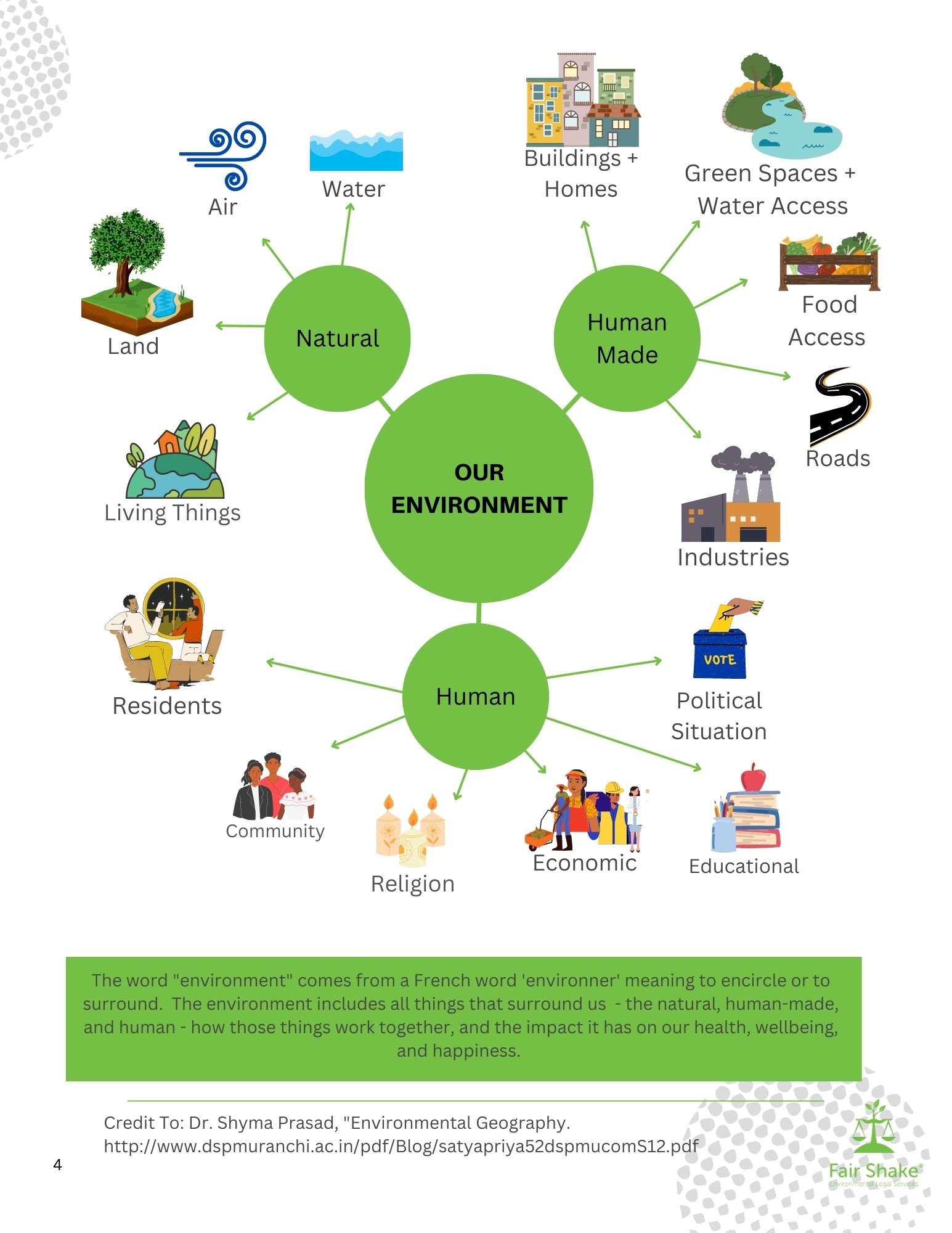
What Makes Up Our Environment?
Learning more about the health and wellbeing of your town can help to think about what is going well in your town, and what needs to be different so that everybody can be happy and healthy.
The word "environment" comes from a French word 'environner' meaning to encircle or to surround.
The environment includes all things that surround us - the natural, human-made, and human - how those things work together, and the impact it has on our health, wellbeing, and happiness.
Decision-Making Power: Community

Charlie’s Wild and Wonderful Adventure Zine
Learn about environmental justice issues, and how to protect advocate for your health with your medical provider!
-
This is a great definition from Detroiters Working for Environmental Justice:
“Environmental justice is based on the reality that certain groups in society bear unequal environmental and economic burdens like poor air and water quality, as well as unhealthy living conditions resulting from industrial, municipal, and commercial operations and/or federal, state, and local laws, regulations, and policies. It is the idea that all people and communities have the right to equal environmental protection under the law, and to the right to live, work and play in communities that are safe, healthy and free of life-threatening conditions. Environmental justice is made possible when all communities have access to information and decision-makers that enable them to take action and create positive change for themselves.” (https://detroitenvironmentaljustice.org/what-is-environmental-justice/)
You can think about 3 Types of Environmental Justice:
Procedural Justice: equal participation in decision-making, especially for the most vulnerable and those most likely to be impacted.
Distributive Justice: fair and equal exposure to environmental harms and amenities or goods.
Recognition Justice: acknowledgement of differences between groups in hopes, needs, histories, including seeing past trauma with environmental burdens. s here
-
The federal government and some states have different activities that are set up to help towns labeled as “environmental justice communities” – those areas that have been marginalized, underserved, and overburdened by pollution.
Knowing if your town is an Environmental Justice Community can help:
Work toward equity.
Find more money that your community is eligible for and deserves.
Put more conditions in place that new businesses or industries would have to meet in the future. (The state should consider in permitting decisions if a community is an Environmental Justice community.)
-
Climate and Economic Justice Screening Tool (EPA): Categories census tracts that are overburdened and underserved as being disadvantaged.
Pros: easy to quickly find out if your community is an EJ community; what the federal government uses for all EJ-related activities.
EJ Screen (EPA): combines environmental and demographic indicators in maps and reports.
Pros: can easily see pollution and sources.
Environmental Justice Index Explorer (CDC): maps communities that have high cumulative impacts of environmental burden and health.
Pros: one of the only that shows the impact of cumulative impacts.
Toxic Release Inventory (EPA): shows how much of toxic chemicals are released to the environment and/or managed through recycling, energy recovery and treatment.
Pros: very detailed information on specific facilities, what they are releasing, and potential health impacts.
Penn Enviro Screen (PA DEP): shows EJ data by census tracts in Pennsylvania.
Pros: PA EPA uses this map and data for any state EJ activities.
-
This activity may be easier for someone or a team who has these strengths:
Strategy + Thinking
Executing + Doing
-
General Environmental Justice:
Environmental Justice, Explained: https://www.youtube.com/watch?v=dREtXUij6_c
US Government Climate & Economic Justice Screening Tool: https://screeningtool.geoplatform.gov/en/
National Equity Atlas: https://nationalequityatlas.org/indicators
State-Specific Environmental Justice:
Ohio Environmental Protection Agency EJ Statement: https://ohioepa.custhelp.com/app/answers/detail/a_id/1097/~/ohio-epa-and-environmental-justice
Ohio Department of Transportation EJ Guidance: https://www.transportation.ohio.gov/programs/environmental-services/manuals-guidance-landing/environmental-justice-guidance
Pennsylvania Department of Environmental Protection Office of Environmental Justice: https://www.dep.pa.gov/PublicParticipation/OfficeofEnvironmentalJustice/pages/default.aspx
West Virginia Department of Environmental Protection Office of Environmental Advocate: https://dep.wv.gov/environmental-advocate/Pages/default.aspx
WV DEP Environmental Equity Policy: https://dep.wv.gov/environmental-advocate/Documents/EnviroEquityPolicy.pdf
Water:
Lead overview: https://www.epa.gov/ground-water-and-drinking-water/basic-information-about-lead-drinking-water
PFAS overview: https://wvrivers.org/pfas/
PFAS map: https://www.ewg.org/interactive-maps/pfas_contamination/map/
Green Spaces:
Green space overview: https://www.nrpa.org/parks-recreation-magazine/2017/april/the-health-benefits-of-small-parks-and-green-spaces/
Air:
Particulate Matter Overview: https://www.cdc.gov/air/particulate_matter.html
Air Quality Map: https://www.airnow.gov/
monitor your air, water, and neighborhood’s environment
Use instruments, websites, and tools to learn and track how healthy your air, water, and the places you spend your time are now.
Having a good understanding of your environment’s health now can help if it’s harmed in the future to show what it was like before.
Decision-Making Power: Community
-
This activity may be easier for someone or a team who has these strengths:
Executing + Doing
Strategy + Thinking
-
Water Monitoring:
WaterQuality Watch: https://waterwatch.usgs.gov/wqwatch/
Environmnetal Working Group PFAS Map: https://www.ewg.org/interactive-maps/pfas_contamination/map/
Stream Monitoring Resources: https://www.dickinson.edu/info/20173/alliance_for_aquatic_resource_monitoring_allarm/2911/volunteer_monitoring/2
WV Rivers Water Quality Monitoring Training + Resources: https://wvrivers.org/our-programs/water-monitoring/
Air Monitoring:
Purple Air Quality Map: https://map.purpleair.com
Real-Time Air Quality Index: https://www.airnow.gov
Global Tree Coverage:
Tree Coverage Map: https://www.globalforestwatch.org/map/country/USA
Urban Heat:
Heat Watch: https://www.capastrategies.com/heat-watch
Oil & Gas Infrastructure:
Fractracker: https://www.fractracker.org/map/
WV Rivers Pipeline Monitoring Manual: https://fdfad2.a2cdn1.secureserver.net/wp-content/uploads/2018/07/WVPipelineManual7.30.2018.pdf
WV Rivers Shale Gas Monitoring Manual: https://fdfad2.a2cdn1.secureserver.net/wp-content/uploads/2018/07/ShaleFieldManual7.31.2018.pdf
Health:
Physicians for Social Responsibility: https://psr.org/
Case Western Health Law Clinic: https://case.edu/law/clinic
Other Issues:
WV Rivers Highway Monitoring: https://fdfad2.a2cdn1.secureserver.net/wp-content/uploads/2023/06/WV_Rivers_HighwayConstructionManual_V3_2023.pdf
Looking for Support?
Tell us how we can help.