
Sylas Yarad, Fair Shake Community Democracy Intern
Residents throughout Pennsylvania, Ohio, and West Virginia, are raising the alarm as new data centers, warehouses, and industrial facilities move in rapidly leading to public concerns surrounding noise, water, and power-usage. How is this happening so fast? Too often, municipalities approve these developments through quiet but completely legal rezoning processes. Many communities are left wondering: Can zoning rules really be changed that easily? Why don't we know about it? How can we get involved before final decisions are made? How does this work, and is there anything I can do about it?
Here's how the zoning process works, how municipalities change their zoning maps and codes, what the legal requirements are, and how you can better advocate to protect your community from these unwanted changes.
What is Zoning?
Local governments use zoning to decide how land is divided between different districts (residential, commercial, industrial, etc.). These different category distinctions are important as they have set regulations for each regarding building size, density, noise, environmental protections, and more. Each municipality adopts a zoning map that shows district boundaries and a zoning code which sets the rules for each district. The zoning process is meant to organize communities and help local governments streamline long-term planning.
What is Rezoning?
Rezoning occurs when a municipality changes the category of restrictions assigned to a piece of land or property in the event that development of the land is not permitted under the current zoning classification. This may change:
the zoning map (ex. turning a residential district into industrial),
the zoning text (changing the rules for what is allowed in a particular district), or
both.
Municipal officials, developers, property owners, or residents typically initiate the rezoning process.
General Steps
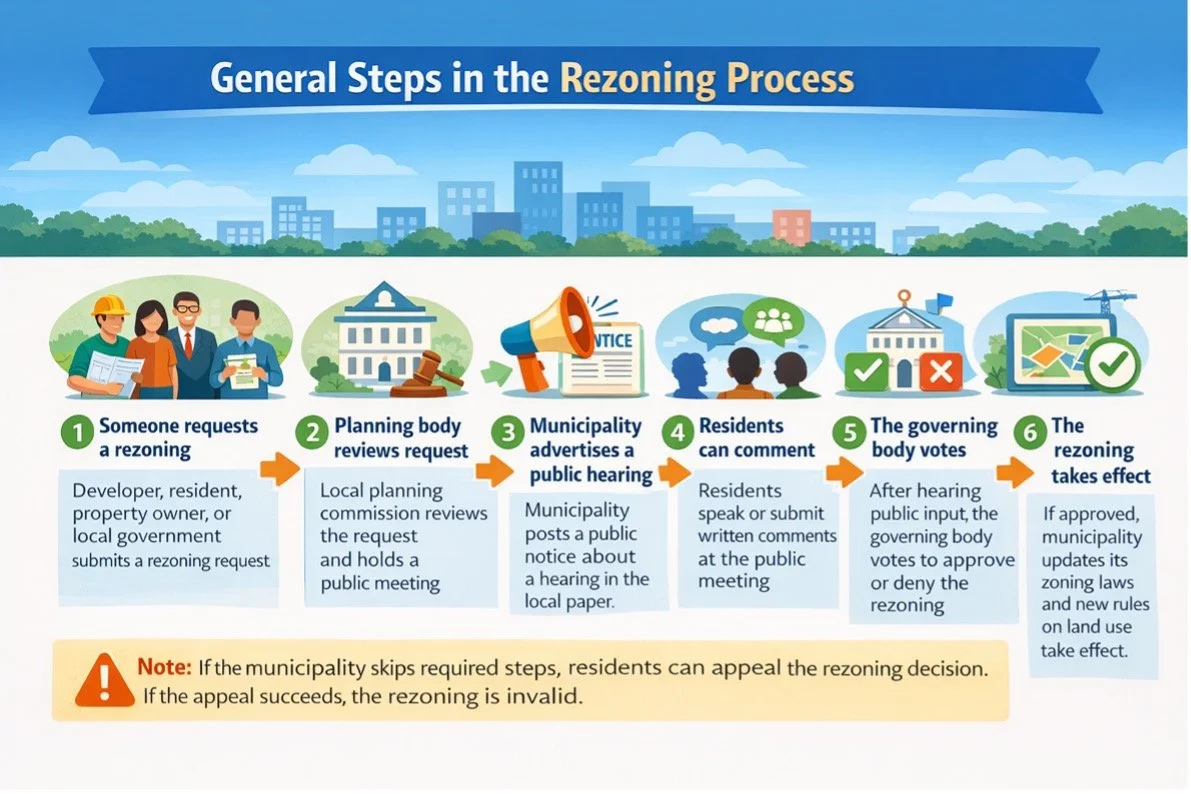
Someone requests a rezoning. The rezoning process usually starts when a developer, resident, property owner, or local government submits a request to change the zoning on a piece of land.
The planning body reviews the request. The local planning commission or board reviews the proposal, and holds a public meeting. This step is important so that the municipality can decide if the rezoning request fits the local goals.
The municipality advertises a public hearing. The municipality holds a public hearing and is required by state law to notify the public of when it will take place. This is usually done by:
A notice in the local newspaper and a notice period determined by state law.
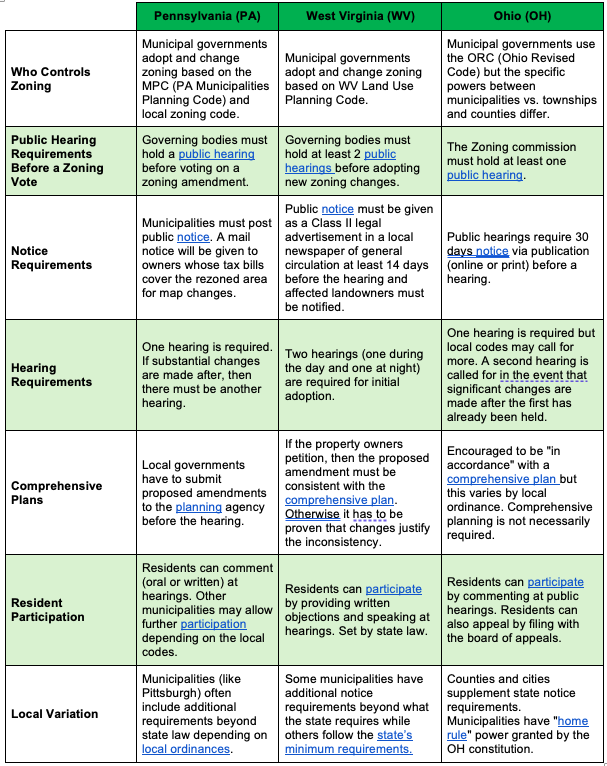
Example - In PA not more than 60 days nor less than 7 days prior to passage, in WV a class II legal advertisement is published once a week for 2 successive weeks, and in OH at least 30 days prior via either newspaper, official public website, or on the website and social media account of the municipality.
Some states, like Pennsylvania, also require conspicuous posting on the tract(s) to be rezoned, and mailed notice to any tracts that will be rezoned. In OH landowners are alerted via certified mail if the zoning change will impact 10 tracts or fewer.
Residents can comment Residents are allowed to share their opinions via spoken or written comments at meetings. However, because most states only require a notice by newspaper and alerting the owners of any tracts that are impacted, neighboring residents are often not notified directly. Therefore, residents don't often get the chance to comment because they do not realize a meeting is taking place.
As a consequence of not knowing what to look for, people sometimes only learn about rezoning decisions after they have already been approved.
The governing body votes. After the public hearing, the governing body votes to either approve or deny the rezoning.
Note: PA, WV, and OH only require one public hearing prior to voting. Most states do not require more than one public hearing UNLESS there are substantial changes made to the proposal after the first hearing has already happened.
The rezoning takes effect. If the governing body approves the rezoning:
The municipality updates the zoning map/code, and
The zoning change becomes effective and enforceable and future development has to follow the new zoning rules.
Note: If the municipality does not follow the rules or skips a required step, the rezoning can be appealed through the zoning board. If the appeal is successful the rezoning becomes invalid (PA, WV, OH).
How Long Does Rezoning Take?
The timeline on rezoning varies from 6 weeks to over a year depending on factors like municipality size, staff capacity, public interest/resistance, and the size and location of the property up for rezoning.
Municipal Structure & Why It Matters
Each type of local government has different resources, staffing, and administrative processes. Because of this, rezoning in certain areas, like a smaller borough versus a big city may be less transparent or well-advertised without violating any laws.
The Census Bureau defines two different types of local government: General Purpose, and Special Purpose. If you understand the specifics of your government, you can better understand what you can do to advocate for yourself and your community. Counties, municipalities, and townships all lie within the "General Purpose" category.
Every municipal structure, whether it be a city, borough, or township, is governed by its own unique municipal code. These codes determine the scope of power these governmental bodies have. The distinction is defined by state law and typically based on factors such as population, density, and historical establishment. Look to see what type of local governance structure your community falls under to better understand how decisions are made and how to best effect change!
Loopholes and Gaps in Transparency
While the following are legal, the particularities of these notice requirements often leave residents feeling uninformed:
State law often requires municipalities to rely solely on newspaper notices and rarely requires direct notification.
Small municipalities may not update online calendars.
Developer-official meetings can occur early before any public involvement can happen. This means that before rezoning applications ever make it to public notice, developers can meet with public officials or municipal staff "informally." Because this is part of internal review, there is no requirement for public notice for these meetings to occur. Although this may feel ‘fishy’, it is legal.
Municipal officials can legally sign NDAs as long as the agreement does not require them to violate state public records laws. Some state laws specifically allow business or financial information to be protected under NDAs, which can limit transparency.
Recent controversies in Allegheny County, such as those happening in Springdale, show just how quickly the process can occur before communities have any opportunity to take action.
Rezoning Process Across PA, WV, & OH
How to Advocate for Your Community in the Zoning Process
1. Attend Planning Commission/City Council meetings
These meetings are where proposals are often first discussed. Attending these meetings early and paying attention to issues and agendas that are brought up allow for residents to raise concerns and spread awareness in the community before any final decisions are reached.
2. Review meetings agendas
Officials often include rezoning discussions as a part of meeting agendas before formal votes are made. Regularly reviewing these agendas, or even forming a small "watchdog" group to track zoning items or proposed changes early is a good way to stay informed before things get too far along.
3. Join municipal notice lists
Many of the notice requirements stipulate at least 2 weeks notice given in local newspapers. However, some municipalities maintain email distribution lists or calendars with upcoming meetings or public hearings. Signing up for an online list and keeping an eye on the calendars can increase your chance of staying in the know, as things in newspapers often go unnoticed.
4. Look into community organizations or RCOs (not always applicable)
Some municipalities, such as Pittsburgh, formally notify RCOs of proposed zoning amendments and allow them to host meetings and engage the community before the public hearings. This depends on the local municipal code and is not guaranteed. However organizations can still play an important role by submitting written comments and showing up at public hearings even if they aren't able to formally petition.
5. Look for the comprehensive plan
A municipality's comprehensive plan will often include the long-term goals for the city's development and plans for land-use. Rezoning decisions are often judged on whether they ultimately serve the comprehensive plan. Becoming active in and understanding your municipalities long term goals can better shape understanding future zoning outcomes before specific projects are proposed.
6. Advocate for stronger notice requirements
Residents can urge local governments to adopt new notice policies that would allow residents to stay better informed. Notices like regularly updated online postings, mandatory neighborhood meetings, or longer notice periods could serve to improve community awareness and allow residents more time to get involved.
7. Become a part of your local government
Residents can become more impactful by running for local office, serving on a planning committee or joining a volunteer zoning board. These bodies have more direct influence and being a part of them increases the chance for more hands-on involvement.
8. Propose zoning changes yourself
In some municipalities, residents or property owners can submit a zoning map/code amendment petition. Local zoning codes determine who can file these requests and the steps they must follow. Some municipalities only allow property owners to do so while others may allow community groups or residents to participate. Residents can check local zoning codes or call their municipality to understand whether or not this option is available.