Written by Hannah Rauh, Fair Shake Volunteer
This blog is designed for general informational purposes only and should not be construed to be legal advice. We recommend reaching out to the appropriate agency with any specific questions around permitting and stream riparian or buffer modifications. You can reach out to us with additional questions at info@fairshake-els.org.
In Ohio, water rights and ownership can be multifaceted and complicated. For landowners with streams running through their property, they might be wondering how much of that stream really belongs to you, or what type of work you can do in the stream, what you might need a permit for, or where you can get those permits. There are many stream improvements you can make on your own property without a permit, and many that you can make with a permit, guided by the county’s conservation district, Ohio EPA, or the Army Corps of Engineers.
It’s important to understand the role a small stream in your backyard plays in local and regional hydrology. Changes you make to a stream running through your backyard may seem insignificant to the health of larger rivers, lakes, or the ocean, but streams of all sizes are contributing factors that provide hydrology to these larger waterbodies. The notion that a small stream connects to and eventually reaches a river describes an essential concept, called a watershed.
A watershed is an area of land that channels precipitation like rainfall or snowmelt into waterways (streams and rivers) and eventually ends up at an outflow point of lakes, bays, or the ocean. (1) Watersheds can be evaluated at different scales—some may encompass only the area the size of your backyard and drain into a stream, and others encompass a significantly larger area, including all the drainage into the Ohio River, Lake Erie, or the like. (2) Each and every stream is within a watershed and will contribute to and join another waterway.
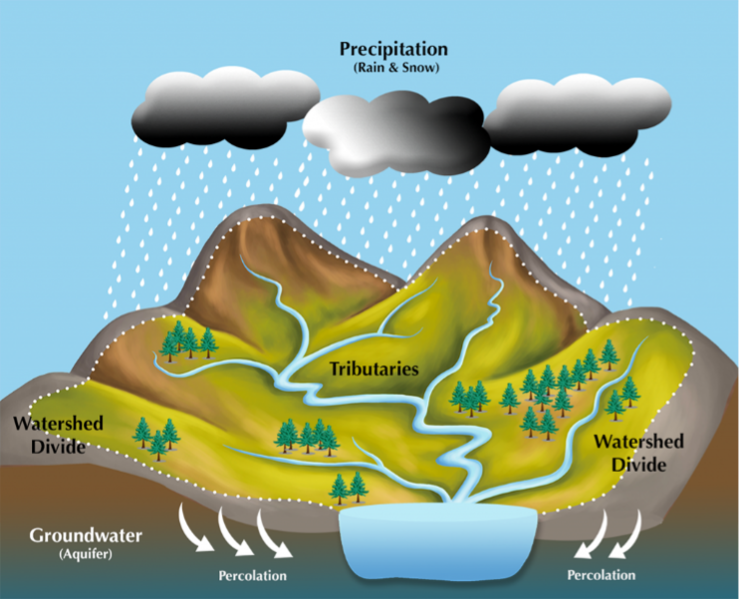
Image credit: Fountain Creek Watershed. What is a Watershed? https://www.fountain-crk.org/what-is-a-watershed
The water may travel incredibly far, whether it be transported in the form of groundwater or flowing in a creek bed. Using the US Geological Survey’s StreamStats application, you can even trace the location of any raindrop on a map; to determine the path that specific drop of water will take and contribute to a larger waterway. (4) Check out the Stroud Water Research Center, called “Model my Watershed” (5), to see a visual representation of your local watersheds on many different scales, and information on the main pollutants that threaten the health of the waterway.
There are three main types of streams to be aware of and understand when you’re trying to determine if you may need a permit for work. These three types are:
Perennial: typically have water flowing in them year-round. Most of the water comes from smaller upstream waters or groundwater while runoff from rainfall or other precipitation is supplemental. (6)
Intermittent: these waterways flow during certain times of the year when smaller upstream waters are flowing and when groundwater provides enough water for stream flow. Runoff from rainfall or other precipitation supplements the flow of intermittent streams. During dry periods, intermittent streams may not have flowing surface water.
Ephemeral: these waterways flow only after precipitation. Runoff from rainfall is the primary source of water for these streams. Like intermittent streams, they can be found anywhere but are most prevalent in arid areas.
All waterways have an outflow point, meaning that they drain to a larger body of water, and if contaminated, will pollute locations further downstream in the watershed. Because all watersheds are connected, some activities that support watershed health are allowed automatically, and some that could harm your own, or neighboring watersheds require permissions (permits) and have specific requirements.
Landowners may be curious as to who has the right to make a decision about a creek on their private property, and the answer is not necessarily a straightforward one. The “right” to make decisions about waterways on a private property is multifaceted and not always just up to the landowner because stream permitting is part of managing waterways for downstream neighbors and wildlife. State and federal agencies both have regulatory jurisdiction over different types of water resources that may flow through private property. It may be helpful to become familiar with the federal and state agencies involved in Ohio that play significant roles in stream work and permitting to help understand who to reach out to when you need a permit and why.
What Type of Stream and Riparian buffer Activities Can I Do?
-
Riparian Buffer (streambank) plantings and Live Staking: A riparian buffer is an area adjacent to a stream, river, lake, or wetland that contains plants that help to filter and clean the water and to help mitigate erosion. (7) Riparian buffers are incredibly important and are being used as green infrastructure to help improve water quality and buffer damage from flooding in many places. Planting a riparian buffer on your streambank can help reduce erosion on your property, attenuate flood damage, improve habitat for many native species, provide beautiful and natural views, and even may increase the value of your property (8). There are copious resources available to anyone with an internet connection regarding the types of plants that will thrive in a riparian buffer. In Ohio, you can access information from the Ohio Department of Natural Resources (9) to see what types of seeds or plants you can order to enhance your property. (9) There are even many seed providers, such as Ernst Seeds, who provide seed mixes specifically tailored to riparian buffer areas that include grasses, wildflowers, and more, that will all work for streambank plantings. (10) Live stake planting, which involves taking a piece of an existing woody stand, cutting it off, and sticking it into the ground to grow, is a method of planting that involves borrowing from an already-thriving tree or shrub. There are only a few species that will successfully take and grow roots as a live stake, and they are: black willow, red osier dogwood, and silky dogwood. (11) Be sure to do research and learn how to properly live stake if you plan to enhance your riparian area with this method, as you don’t want to damage the existing trees by cutting too large of a portion.
Resources and Tips:
Where to find more info or obtain permit:
No permit needed.
Managing invasive plant growth: An additional method of protecting your stream and your property involves manual invasive plant removal. You are allowed to remove and properly dispose of (tip: ID the plant and learn what the most effective removal method is!) invasive species on your property. This leads into an important aspect of plant removal to keep in mind while you’re managing your property—cutting down woody species. You may want to drag woody debris out of the stream, and this is completely fine if it does not require equipment. Putting any sort of machine or heavy equipment within a stream generally requires a permit and corresponding erosion and sediment control practices to make sure you aren’t polluting the water with sedimentation and doing more harm than good. Continue reading below within the section titled: Stream Work Type & Potential Permits, below to learn more about what an erosion and sediment control permit is and what’s involved in this process.
Note: You may remove invasive species but be cautious of removing any woody stumps from the ground without a permit. Sediment is considered a pollutant under Section 404 of the Clean Water Act and is a regulated contaminant. Removing tree stumps without proper protocol and stream protection tools (erosion and sediment controls) can cause soil erosion and water pollution. You may cut down plants and trees on your property (keep in mind, there are other tree felling restrictions you must accommodate to for tree felling) but you must leave the stump unless you have the proper permit. The section titled: Stream Work Type & Potential Permits, below, will discuss permits required for this type of activity. (12)
Resources and Tips:
Where to find more info or obtain permit:
No permit needed.
Monitoring Water Quality: On top of protecting your stream’s riparian buffer, you can also monitor the water quality without needing a permit. When considering the health of a waterway on your property, there are many factors you can evaluate. Particularly relevant and measurable are erosion and sedimentation levels, pH, phosphate and nitrate concentrations. You don’t need a permit to monitor water quality on your own property, which is not only an interesting and educational activity, but is also beneficial to the larger scientific community. Keep in mind that you’ll need property rights or landowner permission to access the stream (if on private property), but any public access point for a waterway is free game to sparingly sample and learn about the water quality.
Resources and Tips:
Where to find more info or obtain permit:
No permit needed.
-
Now that you have an idea about activities you’re able to do within and in your stream that don’t require a permit, it’s time to move onto activities that MAY require a permit.
Streambank stabilization work: Streambank stabilization work is a process with the ultimate goal of reinforcing or protecting the banks or bed of a waterway. This process is often done with an intent of reducing erosion and sedimentation in the stream, therefore protecting water quality. Two different categories of stabilization exist, vegetative stabilization and structural stabilization, and can be used independently or in conjunction with one another. (13) This type of work often places material within or abutting a waterway, generally requiring a permit. Look into Nationwide Permit #13, for Bank Stabilization, to see if your project qualifies.
Vegetative Stabilization includes preserving existing vegetation and/or planting additional vegetation to help reinforce sloped surfaces, since plant roots stabilize the dirt and trap sediment. This type of stabilization can also use brush mattresses, fiber rolls, or existing woody debris to stop sediment transport.
Structural Stabilization commonlyinvolves using non-living material to help provide a waterway with long term stability. Some resources used for structural stabilization include geosynthetic material, rocks placed into revetments, concrete or sandbag placement, and more.
Resources and Tips:
Where To Find More Info or Obtain Permit:
NWP 13- Bank Stabilization- USACE
Repairing a road, bridge, or culvert: These activities will generally require a permit for a few reasons. Since these types of projects are often publicly utilized, structural stability will need to be evaluated by the reviewing agency. The reviewer will also ensure that these proposed activities won’t violate the Clean Water Act, which would include validating the presence of proper erosion and sediment control practices. Placement of a culvert, bridge, or road has the potential to impact and divert flow of jurisdictional waterways, which often require a water encroachment or obstruction permit. This type of work and permitting pathways heavily vary from project to project, as culverts or bridges crossing ditches may be treated differently than those crossing larger, navigable waterways.
Resources and Tips:
Where To Find More Info or Obtain Permit:
NWP 3- Maintenance- USACE
Relocating gravel/rock from the stream channel: This type of stream impact is heavily dependent on the extent of work, and type of machinery used. Any work that removes dirt or involves dredging (commercially or privately), will generally need an Ohio EPA-granted Section 401 Water quality certification, or an alternate type of hyper specific dredging permit from the Ohio DNR. On the other hand, “small-scale recreational prospecting”, for glacial deposited gold, fossils, etc., is considered “exempt” within Ohio state regulated streams. No mechanized digging is allowed without a permit, but hand removal of resources is allowed under Ohio law. Before relocating rock from your stream, ensure you look further into this—as there are regulations about where you can and can’t dig, as well as how deep you’re able to extract. (14)
Resources and Tips:
Nationwide Permit 19 Minor Dredging
Where To Find More Info or Obtain Permit:
NWP 19- Minor Dredging- USACE
-
There are many types of activities that you must obtain a permit to complete – we recommend reaching out to the Ohio Environmental Protection Agency as well as the US Army Corps of Engineers with specific questions or to get clarity before starting your project. There are several common activities, though, that you will need a permit for.
Redirection of stream flow / Relocation of stream: Under Section 10 of the Rivers and Harbors Act of 1899, any unauthorized obstruction or alteration of navigable water (this definition changes and is left to the USACE reviewer’s discretion/best interpretation of federal regulation) is regulated. This includes modification of the course of a waterway, so any redirection or relocation of stream flow would automatically require a federal permit, assuming a federally regulated resource. (15) This type of work will often require a Nationwide Permit (NWP), a USACE granted permit that fits in under Section 404 of the Clean Water Act and/or Section 10 of the Rivers and Harbors Act of 1899. NWPs are standardized permits that authorize activities that impact the aquatic environment. Any redirection or relocation of a federally jurisdictional stream channel would require a permit. Relocation or redirection of a state jurisdictional stream would also require a permit, likely through the OEPA and the ODNR. Since stream relocation involves changing existing stream into wetland or upland area, that would be considered a regulatory impact as it would qualify as “placement of fill”. This type of work gets complicated in Ohio, as Isolated Wetland Permits also become involved depending on the type of resources on your property and where you intend to reroute your stream. Ohio and the US federal regulations mandate compensatory mitigation to offset any impacts resulting from stream alteration or relocation. Mitigation can be incredibly expensive, so avoiding any sort of impact to stream or wetland resources is the first step in the right direction for a project in this category. Redirection of stream flow will require permits from multiple different agencies.
Resources and Tips:
Where To Find More Info or Obtain Permit:
NWP 27- Aquatic Ecosystem Restoration, Enhancement, and Establishment Activities- USACE
Dam a stream: Installing a dam in a stream would fall under redirection or relocation of stream flow, which would require a Section 404 USACE permit as well as a Section 401 Water Quality certification from OEPA, and potentially more permits through the county or township in which the project resides.
Resources and Tips:
Where To Find More Info or Obtain Permit:
ODNR, USACE - Contact your regional office
Build a new bridge, culvert, or crossing through the waterway: As iterated in the last section “Repairing a road, bridge, or culvert”, improvements on a bridge, culvert, road, or crossing through a waterway will likely require a permit. To BUILD a new bridge, culvert, road, or crossing through a waterway, you WILL need a permit. Depending on the type of crossing proposed (minor, temporary), you may fall under pre-approved Nationwide Permits, or Ohio Department of Transportation Regional General Permit. Likely, you will not—as these permits have stringent water classification requirements and very specific impact thresholds. (16)
Resources and Tips:
Where To Obtain More Info or Obtain Permit:
NWP, Individual Permit, General Permit - USACE
Place any type of material in the stream channel: any placement of fill within a stream is prohibited, and fill can include any type of material placed into a stream that doesn’t belong (dirt, riprap, rocks, concrete, logs, etc). Although sometimes strategically placing woody debris or rock can be a form of stabilization for an eroded waterway, if the waterway is federally regulated, you will be required to obtain a Section 404 permit from the US Army Corps of Engineers (USACE). Additionally, dependent upon the classification of your waterway resource, it’s likely you’ll also need an Ohio-granted Section 401 Water quality certification.
Resources and Tips:
Where To Obtain More Info or Obtain Permit:
NWP, Individual Permit, General Permit - USACE
-
Finally, it’s important to note that you are NEVER allowed to dump anything into a stream or waterway. This is not a regulated activity you can obtain a permit for but instead is illegal. There are serious repercussions that can be accrued personally, or by businesses as a result of dumping into a stream. Contamination of water quality without or beyond limits of a NPDES permit or an Ohio Section 401 Water Quality permit can lead to a notice of violation, mandated site restoration, large fines and penalties, and worse, legal action taken against the polluter.
Federal and State Permits
The United States Army Corps of Engineers (USACE) is the main agency that has jurisdiction over federally regulated bodies of water. The Army Corps is designated under the Clean Water Act as the agency required to regulate discharge of dredged or fill material into federally jurisdictional resources (also known as Waters of the United States (WOTUS)). What is considered a jurisdictional resource under one administration may not be considered federally jurisdictional under another, as rollbacks on regulations and implementation of stronger regulations are frequent with changing presidential administrations. USACE is responsible for issuing Nationwide Permits (NWPs) that authorize stream or aquatic environment impacts under the Clean Water Act or the Rivers and Harbors Act of 1899. For yellow or red activities listed in the section called “Traffic Light Permitting” above, you’ll likely be working with the USACE for a permit.
The US Fish and Wildlife Service (USFWS) may also be involved in stream work projects, due to endangered species presence in Ohio. USFWS is responsible for federal species consultation under Section 7 of the Endangered Species Act. Most projects will require a federal species consultation using IPaC to determine if the work being conducted has the potential to harm any federally endangered species. There are many federally listed species in Ohio including many different types of clams and mussels, flowering plants, reptiles, mammals, and insects. This is applicable to stream work due to the many endangered mussels and clams residing in Ohio waterways.
Aside from federal agencies, there are a few different state agencies involved in permitting, consultation, and impacts pertaining to stream work. The agencies most relevant and involved with stream work permitting and consultation include the Ohio Environmental Protection Agency (OEPA) and the Ohio Department of Natural Resources (ODNR).
The ODNR maintains state listed species consultation responsibilities within the state of Ohio. In addition to federally listed species, Ohio has its own state protected/listed species. There are more than 600 listed species in Ohio, including different mammals, birds, amphibians and reptiles, fish, crustaceans, mollusks, and more. For stream projects that require a permit, you will likely need to initiate consultation with the ODNR and request an Environmental Review to ensure no harm to state listed species such as fish, mollusks, and aquatic birds.
The OEPA regulates state jurisdictional aquatic resources and is the state agency that grants Water Quality Certification Permits to ensure discharge of dredged or fill material won’t violate state water quality standards. The OEPA is the main permit grantor for waterway related projects taking place in Ohio. You will need to coordinate with the OEPA for any in stream work that is designated as a yellow or red colored activity, above.
Stream Work and Type of Permits
As there are a multitude of different projects or activities that could be conducted in or around a stream, there are also a multitude of corresponding permits that an applicant could use. Below are some common permit types pertaining to stream work and a brief explanation of their application/purpose.
Nationwide Permit: A federally granted permit, provided by the USACE that authorizes activities with minimal individual and cumulative adverse effects on the aquatic environment. There are many NWP’s, all with varying purposes. USACE Nationwide Permits List
County-based E&S Permit: A county-based permit, often granted through a County Conservation District to comply with the National Pollution Discharge Elimination System (NPDES) Storm Water Program. Erosion and sediment (E&S) permits are in place to ensure waters aren’t contaminated by sediment or runoff from construction.
NPDES Permit: Required for any earth disturbance ≥1-acre in Ohio, permit that regulates discharge of wastewater and federally regulated pollutants, grants discharge of a pollutant from a point source into navigable waters. NPDES permits are required under federal law (under the Clean Water Act), and are implemented by the EPA, or are delegated to the authorized state environmental agency. The EPA generally delegates permitting and enforcement authority to the state, while it holds onto the standard development and review, issuance of permits to non-authorized states, and much more. E&S permits may be required for compliance with NPDES.
401 Water Quality Certification Permit: Ohio EPA granted permit required under Section 401 of the Clean Water Act, that requires state agencies to evaluate any dredge/fill projects involving WOTUS to evaluate if the work will comply with US water quality standards. Only the US Army Corps of Engineers has the jurisdiction to distinguish between a WOTUS (regulatory definition indicating a federally jurisdictional resource) feature and a non-WOTUS feature, which involves a landowner requesting a Preliminary Jurisdictional Determination (PJD), or an Approved Jurisdictional Determination (AJD). These site evaluations help to expedite the permitting process for a person wanting to develop land, do construction, or alter the land in some other way. In order to determine which federal permits may be needed, it's essential for the USACE to first indicate whether or not there are federally jurisdictional resources present on the site. A 401 Water Quality Certification Permit is required for most water work including stream rerouting, culvert placement, filling wetlands, filling and dredging in lakes; any project that may result in a discharge into waters of the United States. (17).
Note: We know this can be confusing! Reach out to your local regulator with more specific clarification needs and questions.
Floodplain Permit: A floodplain permit or floodplain development permit is required “before construction or development begins within any Special Flood Hazard Area (SFHA)”, as defined by the Federal Emergency Management Agency or FEMA. Often distributed by township, these permits are required to ensure that proposed development will stay within the township’s floodplain ordinances as outlined in their zoning code.
Federal Individual Permit: A permit authorized by the USACE for a project/activity with the potential to cause significant environmental impacts.
It’s important to note that permit applicability and need is ultimately under the jurisdiction of the OEPA, USACE, and other regulating agencies, but below, find a chart listing activity types in or around streams, potential permits that may be needed, resources, tips, and links to find more information.
Frequently Asked Questions
-
Where you go for a permit depends on the type of activity you want to complete as well as who has jurisdiction to regulate the resource/activity.
U.S. Army Corps of Engineers, Buffalo District
ATTN: Regulatory Branch
478 Main Street
Buffalo, New York 14202
Phone: (716) 879-4330U.S. Army Corps of Engineers, Huntington District
ATTN: Regulatory Division
502 Eighth Street
Huntington, West Virginia 25701-2070
Phone: (304) 399-5610
Fax: (304) 399-5805U.S. Army Corps of Engineers, Pittsburgh District
ATTN: Regulatory Division
William S. Moorhead Federal Building
1000 Liberty Avenue
Pittsburgh, Pennsylvania 15222-4186
Phone: (412) 395-7155
Fax: (412) 644-4211Ohio Environmental Protection Agency Central Office
50 W. Town St., Suite 700 Columbus, OH 43215(614) 644-3020
County Conservation District/County: Find Your County Conservation District
-
You can plant as much as you’d like, since vegetation helps with bank stabilization, and serves as a filter for water in the system.
-
You may not remove rocks from the stream; this is a regulated activity controlled by OEPA or USACE, dependent on the stream classification and the state.
Note that different classifications of streams are regulated by federal/state governments, sometimes they overlap, sometimes they don’t, and this information changes depending on what’s considered a Waters of the United States under different administrations.
-
Only if you are livestaking, planting riparian buffer, or doing any of the other activities described above in the section titled “doesn’t require a permit”. You can change the bank of your stream with a permit but note that this will involve likely getting a consultant for permit assistance, working with the township, state, and federal regulators (depending on scope and jurisdiction) paying for a stream and wetland delineation and survey, understanding and staying within FEMA regulations, and more.
Please note that non-compliance with stream bank alteration requirements can result in heavy financial repercussions as well as legal action.
-
People can look up their location within a FEMA flood hazard area using this resource: https://msc.fema.gov/portal/home (FEMA Flood map service center)
Check with township websites, they tend to enforce the FEMA regulations, and if the township doesn’t then check the county website for floodplain work regulations and necessary permits.
-
You can, but you’ll likely need a Nationwide permit (likely 3,13,14) or General Permit.
-
No, you cannot ditch your stream or reroute your stream without a permit. To help with stormwater management and water retention, plant native vegetation or live stake your stream banks. If you definitely want to reroute your stream, refer to the table above to get an idea of what permits you’ll need and/or which agencies to begin consultation with.
-
Athens Soil & Water Conservation District
69 S Plains Road, The Plains, Ohio 45780
740-797-9686 / 800-582-8890
Hocking Soil & Water Conservation District
148 N. Homer Ave, Logan, Ohio 43139
740-385-3016
Perry Soil and Water Conservation District
212 S. Main Street, New Lexington, OH 43764
(740) 743-1325
Washington Soil & Water Conservation District
21330 State Route 676, Suite E, Marietta, Ohio 45750
740-373-4857
Morgan Soil and Water Conservation District
167 S. Kennebec Ave. McConnelsville, OH 43756
740-962-4234Morgan County Special Purpose Flood Damage Reduction Resolution
Vinton Soil and Water Conservation District
31935 St Rt 93, McArthur, OH 45651
(740) 596-5676
Meigs Soil and Water Conservation District
113 East Memorial Dr. Suite D., Pomeroy, OH 45769
740-992-4282
Resources
National Oceanic and Atmospheric Administration. What is a watershed? https://oceanservice.noaa.gov/facts/watershed.html
Penn State Extension. Introduction to Watershed. https://extension.psu.edu/introduction-to-watersheds
Fountain Creek Watershed. What is a Watershed? https://www.fountain-crk.org/what-is-a-watershed
USGS. Streamstats. https://streamstats.usgs.gov/ss/
Stroud Research Center. Model My Watershed. https://modelmywatershed.org/draw
United States Environmental Protection Agency. Section 404 Clean Water Act. https://www.epa.gov/cwa-404/learn-about-streams
United States Department of Agriculture. Riparian Forest Buffers. https://www.fs.usda.gov/nac/practices/riparian-forest-buffers.php
Valuation of forested river riparian buffers: Support for riverine integrity and climate resilience. https://www.sciencedirect.com/science/article/abs/pii/S1389934124002600
Ohio Department of Natural Resources. Riparian buffer planting resources
https://dam.assets.ohio.gov/image/upload/ohiodnr.gov/documents/natural-areas/factsheets/Wetlands.pdf
Ernst Seed. Riparian Buffer Mix for Erosion Control. Riparian Buffer Mix for Erosion Control
Penn State Extension. A How to Guide to Live Staking. https://extension.psu.edu/live-staking-a-how-to-guide
United States Environmental Protection Agency. Clean Water Act (CWA) and Federal Facilities.https://www.epa.gov/enforcement/clean-water-act-cwa-and-federal-facilities
Penn State Extension. Streambank Stabilization. https://extension.psu.edu/streambank-stabilization
Ohio Department of Natural Resources. Mineral Resources and Hobby Prospecting. https://ohiodnr.gov/discover-and-learn/safety-conservation/about-odnr/mineral-resources-management/about-the-division/hobby-prospecting-or-panning
Code of Federal Regulations Title 33 Section 320. https://www.ecfr.gov/current/title-33/part-320/section-320.2#p-320.2(b)
Ohio Department of Transportation. Regional General Permit Quick Guide.https://www.transportation.ohio.gov/business/publications/regional-general-permit-quick-guide
Ohio Environmental Protection Agency. Water Quality Certification and Isolated Wetland Permits.https://epa.ohio.gov/divisions-and-offices/surface-water/permitting/water-quality-certification-and-isolated-wetland-permits